
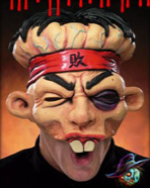
Kung Fool: Racism for Sale in 2002 — A Glimpse Into Early AAPI Activism
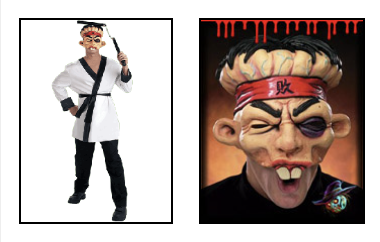
Halloween Costume Kung Fool
Changing out of my suit, I sat at the desk, typed www.yellowworld.org, and waited for it to load.
I had just returned from my judicial externship at the Central District. In chambers, there were two clerks, three externs including me, and a former law clerk who'd returned for the semester. We spent our days researching – locating the right Federal Reporter from the shelves that lined every wall and reading through the hardbound volumes. They smelled of cedar, like the war strategy books that sat on my yeh yeh’s bookshelf. With our heavy Dell laptops and limited internet connection, we typed out memos and laughed over each other’s stories until the fading light told us it was time to walk out to our cars.
Yellowworld had launched a few months earlier. It came after Asian Avenue (shoutout to the Young Professionals! room) and Goldsea, where I had gone just to look at photos of Sean Ching. It gave us something the others didn’t: online forums to have the conversations we never knew we needed. What is affirmative action — good for us, or bad? Did anyone else learn about Vincent Chin? How relevant is it today? The founder was a former intern for The Korea Times and had built the site from scratch.
The forums drew dozens immediately: a fresh engineering grad from Carnegie Mellon who immigrated from Hong Kong; a pair of Japanese American and Chinese American high school students – they were friends; a Korean American woman in Queens who was curious about the topics and just wanted to read about them; a medical student; and my own classmates from the USC Asian Pacific American Law Students Association (APALSA). Our law school did not offer Asian American Jurisprudence, and we were desperate for a place to understand how strict scrutiny and disparate impact applied to our world. Offline, we would have been unlikely friends. But here, we logged on daily – sometimes multiple times a day – to post about racial bullying, imperialism, and share what we ate for lunch.
I took a bite of my dinner and scrolled to see what I missed today.
Kung Fool – the thread title was in bold.
“What. the. Fuck.” someone wrote.
“We can’t let them profit from this,” said another.
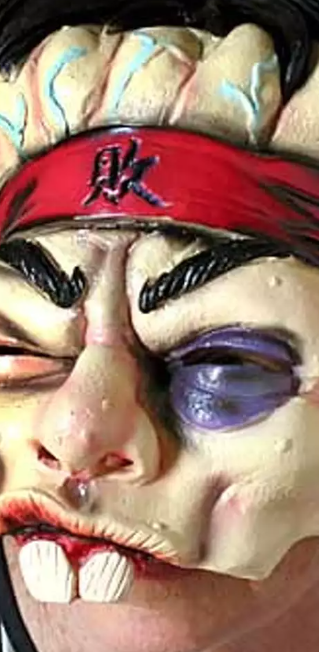
Someone had posted the image: a Halloween mask of an Asian man with squinty eyes — one black and bruised — buck teeth, protruding ears, and a headband bearing the Chinese character, 敗.
Short for 失敗 – defeated.
It was for sale at all major retailers across the country.
I wanted to throw up.
“Buyer beware. I will PUNCH a kid who rings my doorbell wearing this,” wrote another member. He was already practicing and one of my closest law school friends.
On October 10, 2002, we launched our first online petition, demanding that the company remove the costumes.There was no social media — no share buttons, algorithms, or hashtags. Not even platforms like Change.org — that wouldn’t launch for another five years. I emailed it to my parents, cousins, and college roommates — anyone in my contacts who might have been willing to sign and forward to others
A day later, I called the company and left a message. To my surprise, a representative called back. He apologized and said they would pull the costumes.
“Would you please confirm that in writing?” I asked from my apartment living room.
“Um…someone from our legal team will get back to you on that.” They never did.
The following day, I sent a cease-and-desist letter demanding a recall – setting a deadline, October 18, for compliance. I had learned how from my work with a consumer law attorney at LAFLA. I copied the format, then sent it certified, by mail and fax.
As we waited for a response, the signatures trickled in.
Karen Lee, 28, from Los Angeles: "I actually was thinking that the costume couldn't be that bad, but it really is..."
Tania, 15, from Hong Kong: "Gosh. That's just idiotic...."
My dad, who helped organize the I-Hotel protests as a Cal student, told me we needed a campaign name. The company name was Disguise, so we named our campaign Project Anti-Disguise. Then over days, allies, like the editorial team at PoliticalCircus.com, started publishing articles directing people to our petition.
Claire, 27, from CA: "Having been at the brunt of many racist comments in the past, I think it is completely unacceptable and appalling that this company would poke fun at Asians. This issue should not be taken lightly, we will not tolerate DISGUISE Inc. or companies who carry their merchandise. We DEMAND 'Kung-fool' be taken off shelves and an apology be issued by Disguise, Inc."
Grace, 30, from Freehold, NJ: "This is hugely insulting, to me as a Chinese/Asian American and as a HUMAN BEING. This is a kick in the chest to people also like my family and friends and community. This must be stopped!"
Dang Hai Ly, 21, from Boston, MA: "I support Yellowworld fully on their position."
Caroline Frances Buermann, 20, from Sarasota, Florida: "This is unbelievable. Is it really the year 2002?"
With each refresh, dozens more appeared. It became an obsession to check between classes – standing in front of a communal computer in the library, the only way to access the web at our law school.
Refresh.
Will Streeter, 32, from Oakland, CA: "That is one of the most racist things I have seen lately. I am of African-American and Anglo-American descent."
Refresh.
Joseph Lee Sanosa, 38, from Redondo Beach: "Please respect Asian Americans. Would you dare create a similar costume depicting Afro Americans or other Americans of color?"
Refresh.
Linda Tran, 22, from Berkeley, CA. "This is really sad and maddening. We will not allow you to do this."
Refresh.
Yangmin Lee, 23, from New York. "As an Asian teacher in a heavily African-American community, I realize how important it is to educate our children on appreciating diversity. Racist costumes like these should not be tolerated."
Refresh.
Gloria Huang, 23, from Harvard Law School. "I find it appalling and disgusting to imagine how many groups of people — higher management, patent approvers, creative designers — this design must have gone through to get to the stores, and not one recognized it for the filth that it is."
Refresh.
Ana Hernandez, 37, from Arizona: "I agree."
*****
In under a week, groups like the Organization of Chinese Americans announced their support. Then the unexpected happened – we went prime time: NBC aired the mask and our petition. Disguise could no longer ignore us. We made it into living rooms across the United States.
They hired a public relations specialist, who contacted us and representatives of the Organization of Chinese Americans. The corporation would issue a public apology, he said. We can schedule a meeting to discuss this. Up until that point, they had been silent. But now they wanted to negotiate a resolution. That was something I had not yet learned to do in law school.
Our team of moderators and administrators discussed this. We hung out in the Moderator subforum, which was only viewable by moderators and administrators. The water cooler talk and strategy happened there.
“So the company would still sell the costumes?”
In addition to negotiating with Disguise, we also had to come to a consensus with our ally, the Organization of Chinese Americans. The two representatives there were already in the working world and had more experience organizing the community. They said an acknowledgement of wrongdoing, announced publicly, would be a win.
As we approached our deadline of October 18, I was still undecided. I moved through my work in the chambers quietly – a change since I was known to dash from room to room doing my research. “No running in chambers,” my supervising law clerk, Do Kim, would remind me with a smile. But today, palms were clammy from just the idea of having to speak to an external public relations specialist.
Lunch that day was unusual. The judge, the Hon. Robert M. Takasugi, who was a senior federal judge at that point, joined us weekly for motion meetings during the noon hour. This was when I, or one of the two other externs, would summarize motions to him and present our recommendations. This usually happened around a table in the conference room.
Today, the judge ordered Langer’s. Rye bread, pastrami, mustard and mayo laid out on a table in the main room. We made our sandwiches and pulled our chairs into a circle.
I took a bite. Wow. I never had real pastrami before, and the warm, tender meat between fresh rye bread was unlike anything I'd ever experienced.
“Kasie, what’s the update on the costume?” asked Do.
I swallowed my bite. I had been too shy to share about what I was doing with Yellowworld, but by now, most people had caught it on the news.
“They want to apologize. And I’m not sure if we should accept it.” I elaborated on the news segment and the public relations specialist. The judge listened, looking down and laughing pensively. At the end of lunch, we went back to our work.
As I walked down the stairwell of the courthouse that evening, Do joined me. We stood outside to chat so our voices wouldn’t echo.
“So do you know what you are going to do?”
“No.”
“What will you lose by pushing for a recall of the costumes?”
“Nothing.”
“What will they lose if you don’t accept the apology?”
*****
The next day, we made clear that we would accept nothing short of a full recall of the costumes. They had to contact all 20,000 retail outlets they sold to and offer a refund, we said.
On the day of the deadline, they caved. A press conference was held in Poway, California. In the desert-like terrain, we stood for a victory photo op that was published in Sing Tao and the Korea Times.
But that same day, we learned that the battle wasn’t over. Emil Amok, a journalist who covered the Vincent Chin case, had been following our campaign. He called Disguise and followed up with an article that the company was still noncommittal.
That night, we sent out an email blast with the subject header: CALL FOR A NATIONWIDE INVESTIGATION.
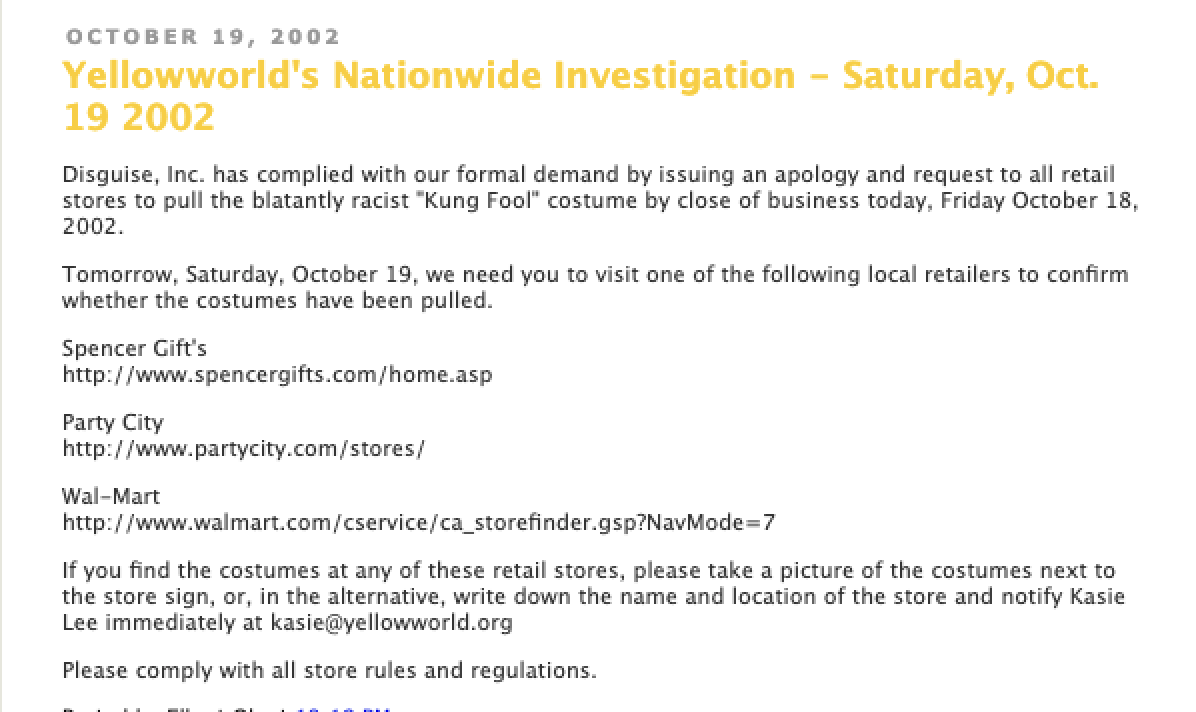
“We have to make sure retailers are pulling all of the costumes from the shelves. We will need your help,” we wrote in the newsletter to the thousands who joined our petition, asking them to email me a photo if they found the costume still in a store.
On Saturday, October 19, 2002, Yellowworld members and supporters walked into Party City, Walmart, and Spencer Gifts across the country. The stores knew we were coming.
As soon as stores opened, I started fielding the emails and posting them in the forum.
“Ken from Cincinnati says he found one on the floor of Party City.”
“Which location?”
“I’ll call them.”
“They said they’d pull. Someone check with Ken.”
“Pulled! He watched a sales rep pull it!”
But then, someone reported they saw it on eBay.
We looked up their policies. “This is against your own policies,” we wrote. Within hours, the post was down.
As it grew dark, two law school classmates dropped in. Their perfume and laughter filled the apartment. They had dinner plans with my roommate. “What’s the update?” they asked. “Come eat.” On another day, I would have, but I couldn’t leave the screen today. They left, their voices trailing: “So racist. Unbelievable.” They had already signed the petition early on.
By the end of the weekend, we were confident that all costumes had been pulled. We made the final announcement to our petitioners.
While giving virtual high-fives, a high schooler asked: "What if they donate these costumes to the Salvation Army?” A legitimate concern, I thought, but we tabled it for another day.
